Renovate, Refresh, or Move? Finding What’s Right for the Home You’re In
There’s a moment a lot of homeowners describe almost the same way. You’re standing in your kitchen on an ordinary Tuesday, and you catch yourself thinking: I love this house. I just wish it worked better.
Maybe you’ve started scrolling listings late at night. Not because anything’s wrong, exactly but because you’re wondering if there’s a version of your life that fits a little more comfortably.
That wondering is worth taking seriously. And it usually has more than two answers.
What you’re actually deciding
It’s tempting to treat this as a spreadsheet question. Cost of remodeling versus cost of moving, whichever number is smaller wins.
But that’s not how anyone actually lives in a house.
A home isn’t a line item. It’s where your kids grow up, where you host Thanksgiving, where you drink coffee every single morning for the next however many years. When you put money into it, you’re not really buying countertops. You’re buying the version of your daily life that happens on top of them.
That’s a different kind of decision and a much more personal one. So instead of asking which option is cheaper, it helps to ask a simpler question:
How much longer do I want this house to be the center of my life?
Your answer points to one of three good paths.
Path one: refresh it now, and stay open to the future
This one gets overlooked, and it’s often the smartest place to start.
Maybe you think you’ll move in three or four years. Maybe the job situation isn’t settled, or you’re waiting to see where the kids land, or you just don’t want to commit to anything permanent yet.
You don’t have to choose between a gut renovation and living with a kitchen you dread.
A refresh works within what’s already there. What changes is how the space feels every day.
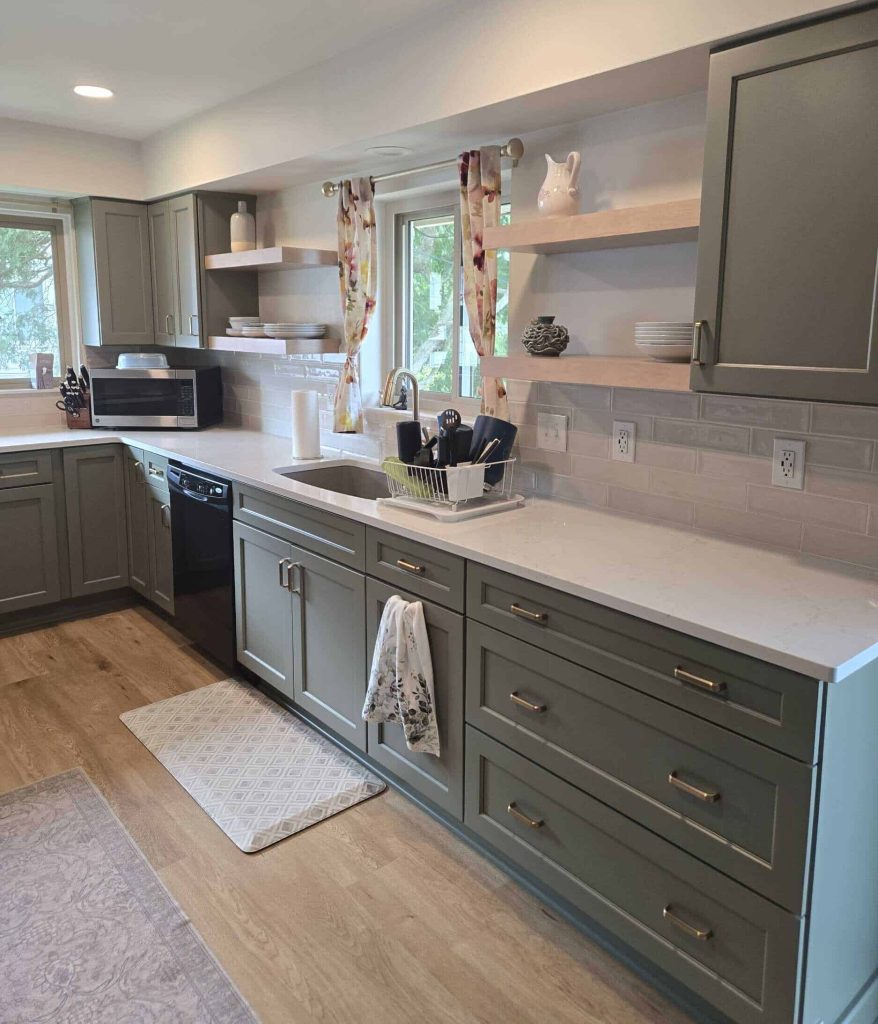
This tends to run in the $15,000 to $25,000 range for a bathroom or a kitchen refresh, and it does two things at once: it makes the house genuinely nicer to live in right now, and it makes it easier to sell when you’re ready. Buyers respond to updated kitchens and bathrooms. You get to enjoy them in the meantime.
That’s not a compromise. That’s just matching the investment to the timeline. If you’re not sure how long you’re staying, this is often exactly the right call.
Path two: invest fully in the home you’re keeping
Some people already know. This is the house. The location is right, the neighborhood is right, and they can picture the next fifteen years here clearly.
If that’s you, the calculation changes completely. You’re not protecting resale value you’re buying years of your own life being better.
That’s when the bigger projects make sense. Moving a wall so the kitchen actually opens to where everyone gathers. Building the primary bath you’ve been sketching in your head. Finishing the basement so the house grows without moving an inch.
One honest note: a remodel won’t return every dollar at resale. Nobody’s does. The real return is the years you spend in it. If that’s what you’re buying, it’s one of the better purchases you’ll make.
Path three: find a home that fits better
And sometimes the right answer is a different house.
There’s nothing wrong with that, and we’d never try to talk you out of it. Some things a renovation genuinely can’t solve. A school district, a lot that’s too small or too steep, a commute that’s wearing you down, a layout that would require rebuilding the structure to fix. Sometimes life is simply pointing somewhere else.
If your honest answer to “what would I change?” is the location, the land, or the size of the footprint itself, then moving isn’t a failure of imagination. It’s the right call, and you should make it with confidence.
Even then, path one often comes first. Updating the kitchen or main bath before you list tends to make the house show better and move faster and you get to enjoy it for the months you’re still there.
A question that usually settles it
Picture the house with the kitchen, bathrooms, and space you actually want. Same street, same yard, same neighbors, same view out the window.
Would you still be scrolling listings?
If yes, you’re not looking for a renovation. You’re looking for a different place, and that’s useful to know.
If no, if that imagined version of your house is one you’d happily stay in then what you have isn’t a house problem. It’s a two-or-three-room problem. And that’s a much smaller, much more solvable thing than it feels like at eleven o’clock at night with a real estate app open.
Common questions
Should I remodel if I might move in a few years?
Often yes, but at a smaller scale. A refresh updates the spaces you use most without committing to a full renovation, and updated kitchens and bathrooms tend to help when you do list.
Can I renovate in phases?
Yes, and many families do. Kitchen one year, basement a couple years later. Planning the full scope up front keeps the phases working together instead of undoing each other.
Do I have to move out during the work?
Usually not. Most families stay put through a bathroom or basement project. Kitchens are more disruptive, and a lot of people set up a temporary kitchen elsewhere in the house for a few weeks.
If you’re still turning it over
That’s completely normal, and it’s not something you settle from an article.
If it would help to talk it through with someone standing in the actual room, we’re glad to come out, look at the space with you, and give you a real sense of what’s possible at a few different levels — refresh, full remodel, or somewhere in between.